 Assisted Reproduction Center
 Assisted Reproduction Center
HYSTEROSALPINGOGRAPHY or Hysterosalpingography (HSG): detailed guide and patient memo
Hysterosalpingography combines two terms related to gynecological exploration: the uterus (metro) and the fallopian tubes (salpingoscopy), also known as hysterosalpingography HSG. It is a very informative diagnostic procedure that serves as the “reference” for initial examination when planning a pregnancy. The main goal of the examination is to objectively and visually assess the patency of the fallopian tubes, as well as to carefully inspect the state of the uterine cavity to detect any possible pathological formations.
Why is this procedure performed?
This examination is a fundamental and mandatory step in diagnosing the causes of infertility. A clear understanding of the anatomical characteristics of the patient's reproductive system allows the specialist to choose the appropriate treatment strategy, avoiding methods that will clearly not yield results.
The results of hysterosalpingography help the doctor make an informed decision regarding the necessity of next steps:
- Planning natural conception or performing intrauterine insemination (IUI). These methods are effective only if the fallopian tubes are patent, as sperm must be able to reach the egg unobstructed. If the tubes are blocked, attempts at natural conception or insemination will only be a waste of time and emotional energy.
- Prescription of an in vitro fertilization (IVF) procedure. If the examination reveals that the fallopian tubes are blocked or absent, IVF becomes the primary method of choice, with no alternatives. In this case, fertilization occurs in the laboratory (outside the body), and the embryo is immediately transferred into the uterus, bypassing the damaged parts of the tubes.
- Preparation for complex protocols, such as IVF with egg donation or the FIV with double donation. In these cases, it is extremely important to first ensure not only permeability but also absence of pathologies. For example, the presence of fluid in the tubes (hydrosalpinx) can have a toxic effect on the embryo, and polyps or synechiae in the uterus can prevent implantation. Identifying and resolving these issues before starting costly programs greatly increases the chances of success.
Thus, hysterosalpingography not only diagnoses the problem but also saves time and money for the patient by guiding immediately towards the shortest and most appropriate path to parenthood.
Conditions and method of performance
To ensure maximum reliability and relevance of results, the procedure is performed strictly within a specific time frame: from the 7th to the 12th day of the menstrual cycle.
- Why precisely these days? During this period, menstruation has already ended, and the endometrium (inner layer of the uterus) is still sufficiently thin. This allows the doctor to examine the uterine cavity in detail without interference from a thick endometrial layer during the second phase of the cycle. Moreover, during these days, the cervix is more flexible, facilitating the insertion of the catheter.
An important condition is that the procedure be done on an empty stomach (at least 6 hours of fasting). This requirement is due to safety rules during anesthesia, to exclude the risk of aspiration (stomach contents entering the respiratory tract).
Principle of the method
The procedure is performed under short-term intravenous anesthesia (sedation). The patient is put into a medicated sleep, which completely eliminates pain, fear, and muscle tension that could cause spasms of the tubes and distort the results.
Technically, the process proceeds as follows:
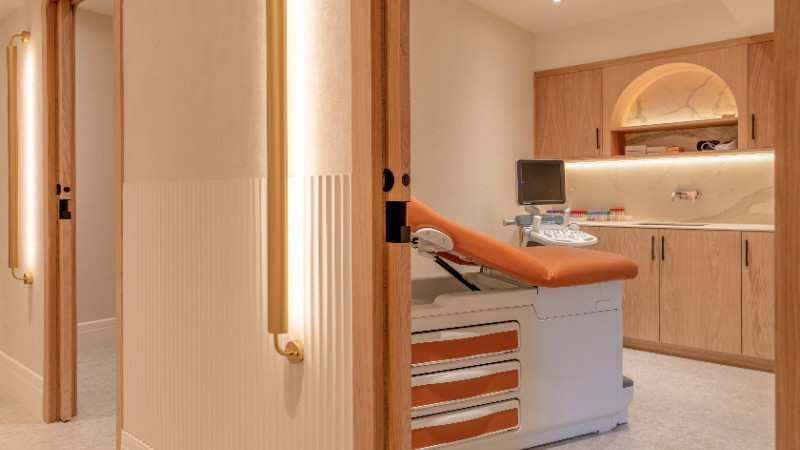
- The patient is positioned in a gynecological chair. After disinfecting the external genital organs, a contrast agent (usually a sterile saline solution or a special ultrasound gel) is gently introduced into the uterine cavity through the cervix using a thin, flexible, and sterile catheter.
- The doctor uses a transvaginal ultrasound probe to observe the movement of the liquid in real time. The specialist evaluates how the solution fills the uterine cavity (excluding filling defects such as polyps) and whether it enters the ostia of the right and left fallopian tubes.
- The key criterion of permeability is visualizing free liquid in the post-uterine space (Douglas pouch). If the liquid flows freely from the ends of the tubes and accumulates behind the uterus, it indicates that the tubes are anatomically permeable and functional.
Preparation for the intervention: necessary examinations
Hysterosalpingography is an invasive procedure (involving penetration into the sterile cavity of the uterus), therefore, it requires careful preparation. Analyses are necessary to minimize risks of complications such as inflammation or bleeding.
The patient must undergo the following tests:
- Blood test (general analysis with leukocyte formula) – shows the overall health status and the presence of hidden inflammatory processes.
- Urinalysis – necessary to evaluate kidney function and exclude any urinary tract inflammation near reproductive organs.
- Blood type and Rh factor determination – an essential safety standard before any medical intervention in case of emergency.
- Coagulogram (blood coagulation parameters analysis) – enables the doctor to ensure that the patient does not have a risk of prolonged bleeding after the procedure.
- Serological tests: screening for HIV, syphilis, hepatitis B and C – standard hospital screening tests.
- Gynecological smear for flora (microscopy of vaginal and cervical secretions) – determines the cleanliness level of the vagina.
- Cytological examination of cervical and endocervical smears (Pap test).
Important: the smear for flora should be of a perfect quality (cleanliness level 1-2). If the smear shows a substantial presence of leukocytes or pathogenic flora, the procedure cannot be performed, as infection could be transmitted from the vagina to the uterus and tubes with the liquid.
Contraindications
Hysterosalpingography is strictly contraindicated or should be postponed in the following situations:
- Inflammatory processes: Detection of any acute or subacute inflammation in the pelvic organs (cervicitis, vaginitis). Performing the procedure under these conditions risks spreading the infection and developing peritonitis.
- Infectious diseases: Presence of acute systemic infections (e.g., flu, angina, active herpes). The organism is weakened during this period, and any intervention may lead to complications.
- Fever: significant unexplained increase in body temperature.
- Uterine bleeding: any bleeding from the genital tract on the day of the procedure.
Diet and pre-procedure regimen
Preparation of the body starts well in advance. Three days before the scheduled hysterosalpingography, it is necessary to adjust the diet to prevent intestinal gas buildup:
- Eliminate foods high in fiber and that cause increased gas formation (flatulence). This includes legumes (peas, beans), all varieties of cabbage, fresh baked goods with yeast, and pastries, carbonated drinks, whole milk, as well as raw fruits and vegetables in large quantities.
- Why is this important? Inflated intestinal loops filled with gas can “obstruct” ultrasound waves and create acoustic shadows that may obscure the ovaries and tubes. This makes imaging difficult or impossible.
- Alcohol consumption is strictly prohibited. It affects blood clotting and interacts with anesthetic medications.
Post-intervention: diet and recovery
Restrictions:
In the first days after the procedure, the cervix remains slightly open, and the mucosa may be slightly traumatized by the catheter. To avoid complications, it is contraindicated to:
- Strenuous physical activity: engaging in excessive efforts (gym, running, fitness).
- Sexual activity: having intercourse before bleeding completely stops (usually 3 to 5 days) to prevent ascending infection.
- Thermal procedures: Taking hot baths, going to the bathhouse, sauna, or solarium. Heat causes blood vessels to dilate and may provoke uterine bleeding. Only warm showers are permitted.
- Lifting heavy objects: lifting objects weighing more than 3 kg (restriction valid for one week).
Important! If after the procedure you experience sharp, throbbing pain that cannot be relieved by analgesics, if your temperature suddenly exceeds 38°C, or if you start experiencing heavy bleeding (more than during a normal period), do not self-treat—immediately contact the clinic or call an ambulance.
Attention! Remove the sanitary pad from the vagina (if placed by the doctor) 6 hours after the end of the procedure to prevent creating an environment conducive to bacterial proliferation.
Recommendations (what you can and should do)
- Diet and hydration. You can eat and drink once your swallowing reflex is restored. If the anesthetist did not give other instructions, you can start drinking water one hour after awakening, taking small sips. You can begin eating light, non-fatty foods (broth, yogurt, porridge) as soon as drowsiness disappears and there are no more nausea or abdominal discomfort.
- Help from relatives. During the first 24 hours after anesthesia, reaction speed may be reduced, and slight weakness or dizziness are possible. The patient needs rest. It is advisable that an adult accompanies them home, helps with daily tasks, and provides moral support.
- Rest and work. It is strongly recommended to rest completely for at least 24 hours following the procedure. The body needs time to recover from stress. Plan your schedule so as not to return to work or make important decisions on the day of the procedure.
- Care for children and close ones. Since you will need to stay in bed, arrange in advance with friends, babysitters, or relatives to take care of your children or elderly family members the evening after the procedure.
Warning symptoms: when to urgently see a doctor
Immediately consult a medical center or call an ambulance if the following symptoms appear:
- Persistent increase in body temperature above 37.5°C, accompanied by chills.
- Sudden change in the nature of vaginal discharge (foul smell, purulent inclusions yellow-green, abundant bright red bleeding with clots).
- Severe and unbearable pain in the groin or lower abdomen, radiating to the rectum.
- Sharp pain, burning, and intense discomfort during urination.
- Difficulty urinating, urinary retention, or visible blood in urine.
- Sudden general deterioration of health, pronounced weakness, persistent nausea, or repeated vomiting.
- Appearance of oppressive pain in the heart region, shortness of breath, or difficulty breathing.
FAQ: Frequently Asked Questions
Question 1: Is this procedure painful? Answer: The procedure itself is performed under intravenous sedation (medicated sleep), so the patient feels no pain during manipulation. You simply fall asleep and wake up once the examination is finished. Upon awakening, you may experience slight discomfort in the lower abdomen (like the first day of your period), which can be easily relieved by simple analgesics and typically passes within a few hours.
Question 2: How long does the procedure take? Answer: The technical part (catheter insertion, solution administration, ultrasound) takes about 15 to 20 minutes. However, the total clinic stay is 2 to 3 hours. This time is spent on paperwork, consulting with the anesthetist, preparing for anesthesia, and especially monitoring in the recovery room until you are fully alert.
Question 3: When can pregnancy be planned after hysterosalpingography? Answer: Generally, doctors allow attempts at conception to resume after the next menstrual cycle. During the cycle in which the procedure was performed, it is necessary to use contraception (since the uterine cavity was involved and medications were used). Interestingly, in the 2-3 months following the procedure, chances for natural conception often increase. This is because the pressurized fluid flow can “clean” the tubes, removing minor adhesions and mucous plugs.
Question 4: Why is it so important to follow a low-flatulent diet? Answer: This is not a whim of doctors but a guarantee of accurate diagnosis. The intestine closely surrounds the uterus and ovaries. If it accumulates gases, it acts as an “obstacle” for ultrasound waves, creating interference and shadows on the monitor. As a result, the doctor might simply not see the tube openings or misinterpret the movement of the liquid, leading to incorrect results and possibly unnecessary treatment.
Question 5: Can I drive after the procedure? Answer: No, this is strictly prohibited. The medications used for anesthesia, even short-term, affect the central nervous system: they slow reflexes, impair alertness, and can cause drowsiness. Even if you feel perfectly fine, the risk of accidents persists for 24 hours. Please take a taxi or ask your relatives for help.

Dr. Cristina Pérez
Specialist in Assisted Reproduction
Medical Director
Medical Director
Dr. Jean-Paul Bouiller
Specialist in Assisted Reproduction
Dr. Frédéric Lamazou
Specialist in Assisted Reproduction
Dr. Karinna Lattes
Chief Scientific Officer
Dr. Elena Prada
Specialist in Assisted Reproduction
Dr. Maria Jesús Puy
Specialist in Assisted Reproduction
Dr. Patricia Zabala Franco
Specialist in Assisted Reproduction
Have questions?
Request your free consultation today!
Our experts are ready to examine your case history, clarify your choices, and address every question you have.
Don't wait to make informed decisions – your personalized guidance awaits!
The field is filled in incorrectly
+34
- Spain (España)+34
- France (La France)+33
- Italy (Italia)+39
- United Kingdom+44
- United States+1
- Belgium (België)+32
- Switzerland (Schweiz/Suisse)+41
- Germany (Deutschland)+49
- Netherlands (Nederland)+31
- Afghanistan (افغانستان)+93
- Albania (Shqipëri)+355
- Algeria (الجزائر)+213
- American Samoa+1
- Andorra+376
- Angola+244
- Anguilla+1
- Antigua and Barbuda+1
- Argentina+54
- Armenia (Հայաստան)+374
- Aruba+297
- Ascension Island+247
- Australia+61
- Austria (Österreich)+43
- Azerbaijan (Azərbaycan)+994
- Bahamas+1
- Bahrain (البحرين)+973
- Bangladesh (বাংলাদেশ)+880
- Barbados+1
- Belarus (Беларусь)+375
- Belize+501
- Benin (Bénin)+229
- Bermuda+1
- Bhutan (འབྲུག)+975
- Bolivia+591
- Bosnia and Herzegovina (Босна и Херцеговина)+387
- Botswana+267
- Brazil (Brasil)+55
- British Indian Ocean Territory+246
- British Virgin Islands+1
- Brunei+673
- Bulgaria (България)+359
- Burkina Faso+226
- Burundi (Uburundi)+257
- Cambodia (កម្ពុជា)+855
- Cameroon (Cameroun)+237
- Canada+1
- Cape Verde (Kabu Verdi)+238
- Caribbean Netherlands+599
- Cayman Islands+1
- Central African Republic (République centrafricaine)+236
- Chad (Tchad)+235
- Chile+56
- China (中国)+86
- Christmas Island+61
- Cocos (Keeling) Islands+61
- Colombia+57
- Comoros (جزر القمر)+269
- Congo (DRC) (Jamhuri ya Kidemokrasia ya Kongo)+243
- Congo (Republic) (Congo-Brazzaville)+242
- Cook Islands+682
- Costa Rica+506
- Côte d’Ivoire+225
- Croatia (Hrvatska)+385
- Cuba+53
- Curaçao+599
- Cyprus (Κύπρος)+357
- Czech Republic (Česká republika)+420
- Denmark (Danmark)+45
- Djibouti+253
- Dominica+1
- Dominican Republic (República Dominicana)+1
- Ecuador+593
- Egypt (مصر)+20
- El Salvador+503
- Equatorial Guinea (Guinea Ecuatorial)+240
- Eritrea+291
- Estonia (Eesti)+372
- Eswatini+268
- Ethiopia+251
- Falkland Islands (Islas Malvinas)+500
- Faroe Islands (Føroyar)+298
- Fiji+679
- Finland (Suomi)+358
- French Guiana (Guyane française)+594
- French Polynesia (Polynésie française)+689
- Gabon+241
- Gambia+220
- Georgia (საქართველო)+995
- Ghana (Gaana)+233
- Gibraltar+350
- Greece (Ελλάδα)+30
- Greenland (Kalaallit Nunaat)+299
- Grenada+1
- Guadeloupe+590
- Guam+1
- Guatemala+502
- Guernsey+44
- Guinea (Guinée)+224
- Guinea-Bissau (Guiné Bissau)+245
- Guyana+592
- Haiti+509
- Honduras+504
- Hong Kong (香港)+852
- Hungary (Magyarország)+36
- Iceland (Ísland)+354
- India (भारत)+91
- Indonesia+62
- Iran (ایران)+98
- Iraq (العراق)+964
- Ireland+353
- Isle of Man+44
- Israel (ישראל)+972
- Italy (Italia)+39
- Jamaica+1
- Japan (日本)+81
- Jersey+44
- Jordan (الأردن)+962
- Kazakhstan (Казахстан)+7
- Kenya+254
- Kiribati+686
- Kosovo+383
- Kuwait (الكويت)+965
- Kyrgyzstan (Кыргызстан)+996
- Laos (ລາວ)+856
- Latvia (Latvija)+371
- Lebanon (لبنان)+961
- Lesotho+266
- Liberia+231
- Libya (ليبيا)+218
- Liechtenstein+423
- Lithuania (Lietuva)+370
- Luxembourg+352
- Macau (澳門)+853
- North Macedonia (Македонија)+389
- Madagascar (Madagasikara)+261
- Malawi+265
- Malaysia+60
- Maldives+960
- Mali+223
- Malta+356
- Marshall Islands+692
- Martinique+596
- Mauritania (موريتانيا)+222
- Mauritius (Moris)+230
- Mayotte+262
- Mexico (México)+52
- Micronesia+691
- Moldova (Republica Moldova)+373
- Monaco+377
- Mongolia (Монгол)+976
- Montenegro (Crna Gora)+382
- Montserrat+1
- Morocco (المغرب)+212
- Mozambique (Moçambique)+258
- Myanmar (Burma) (မြန်မာ)+95
- Namibia (Namibië)+264
- Nauru+674
- Nepal (नेपाल)+977
- New Caledonia (Nouvelle-Calédonie)+687
- New Zealand+64
- Nicaragua+505
- Niger (Nijar)+227
- Nigeria+234
- Niue+683
- Norfolk Island+672
- North Korea (조선 민주주의 인민 공화국)+850
- Northern Mariana Islands+1
- Norway (Norge)+47
- Oman (عُمان)+968
- Pakistan (پاکستان)+92
- Palau+680
- Palestine (فلسطين)+970
- Panama (Panamá)+507
- Papua New Guinea+675
- Paraguay+595
- Peru (Perú)+51
- Philippines+63
- Poland (Polska)+48
- Portugal+351
- Puerto Rico+1
- Qatar (قطر)+974
- Réunion (La Réunion)+262
- Romania (România)+40
- Russia (Россия)+7
- Rwanda+250
- Saint Barthélemy+590
- Saint Helena+290
- Saint Kitts and Nevis+1
- Saint Lucia+1
- Saint Martin (Saint-Martin (partie française))+590
- Saint Pierre and Miquelon (Saint-Pierre-et-Miquelon)+508
- Saint Vincent and the Grenadines+1
- Samoa+685
- San Marino+378
- São Tomé and Príncipe (São Tomé e Príncipe)+239
- Saudi Arabia (المملكة العربية السعودية)+966
- Senegal (Sénégal)+221
- Serbia (Србија)+381
- Seychelles+248
- Sierra Leone+232
- Singapore+65
- Sint Maarten+1
- Slovakia (Slovensko)+421
- Slovenia (Slovenija)+386
- Solomon Islands+677
- Somalia (Soomaaliya)+252
- South Africa+27
- South Korea (대한민국)+82
- South Sudan (جنوب السودان)+211
- Spain (España)+34
- Sri Lanka (ශ්රී ලංකාව)+94
- Sudan (السودان)+249
- Suriname+597
- Svalbard and Jan Mayen+47
- Sweden (Sverige)+46
- Syria (سوريا)+963
- Taiwan (台灣)+886
- Tajikistan+992
- Tanzania+255
- Thailand (ไทย)+66
- Timor-Leste+670
- Togo+228
- Tokelau+690
- Tonga+676
- Trinidad and Tobago+1
- Tunisia (تونس)+216
- Turkey (Türkiye)+90
- Turkmenistan+993
- Turks and Caicos Islands+1
- Tuvalu+688
- U.S. Virgin Islands+1
- Uganda+256
- Ukraine (Україна)+380
- United Arab Emirates (الإمارات العربية المتحدة)+971
- Uruguay+598
- Uzbekistan (Oʻzbekiston)+998
- Vanuatu+678
- Vatican City (Città del Vaticano)+39
- Venezuela+58
- Vietnam (Việt Nam)+84
- Wallis and Futuna (Wallis-et-Futuna)+681
- Western Sahara (الصحراء الغربية)+212
- Yemen (اليمن)+967
- Zambia+260
- Zimbabwe+263
- Åland Islands+358
The field is filled in incorrectly
Visit our clinic
We are located in the heart of Barcelona.
Location
Call us now
Leave a message